![Asset 2.png]](https://www.cotes.com/hs-fs/hubfs/Asset%202.png?height=22&name=Asset%202.png)
After a pig stable has been washed and cleaned, significant amounts of moisture can remain in concrete floors, walls and equipment. Even when surfaces appear dry, residual moisture can continue to evaporate for an extended period.
This evaporation requires energy, which is drawn from the surrounding air and surfaces. As a result, floor temperatures can decrease, creating a colder and more humid microclimate close to the floor, where pigs spend much of their time. This is particularly relevant for young piglets, which are sensitive to changes in their immediate thermal environment.
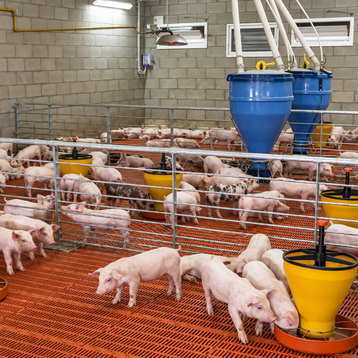
Traditional drying methods often rely on heating and ventilation. However, heating alone does not remove moisture, and ventilation effectiveness depends on the humidity of the incoming outdoor air.
By actively removing water vapour from the air, adsorption dehumidification increases the air's capacity to absorb moisture from wet surfaces. Combined with suitable air circulation, this supports faster and more controlled drying of floors, walls and equipment.
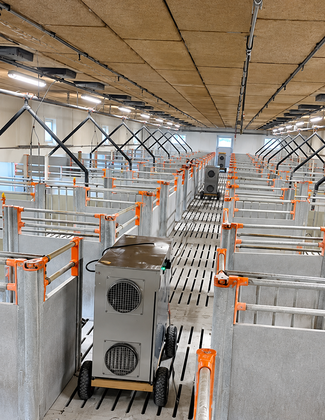
The result is a more predictable drying process, helping farmers prepare the stable for the next batch while reducing the risk of residual moisture affecting the indoor climate.