Cotes Product Image_CH26_Hero Image_12122025
WebSite Product Images 1000x1000 CH26
Product Thumbnail 1000x1000 How DHU works
Cotes Product Image_CH26_Hero Image_12122025
WebSite Product Images 1000x1000 CH26
Product Thumbnail 1000x1000 How DHU works
Cotes Hybrid

CH26

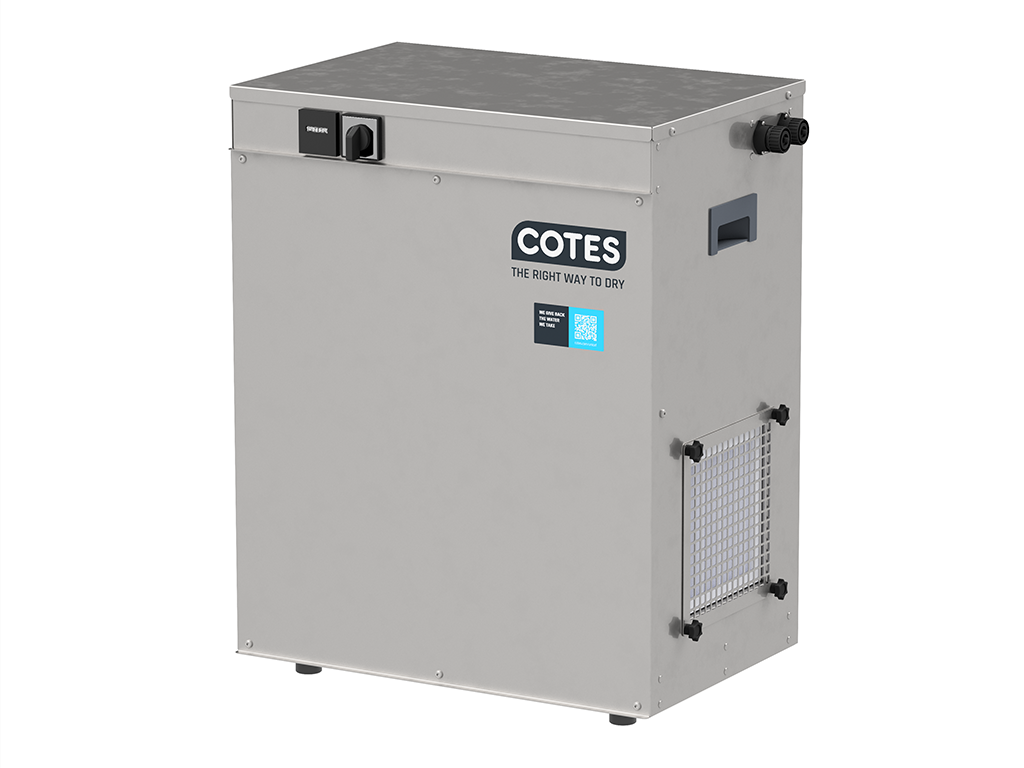
Hybrid adsorption dehumidifier for installations without regeneration air ducting   

The CH26 is part of the Cotes Hybrid product family — adsorption dehumidifiers designed to operate without external regeneration air ducting.

The unit combines adsorption drying with internal condensation, allowing moisture removed from the rotor to be discharged as liquid water through a drain connection rather than through regeneration air exhaust.

This hybrid principle allows installation in locations where external ducting is not feasible or not permitted.

Explanation of Naming

The product designation follows Cotes naming logic:

  • C – Cotes adsorption platform
  • H – Hybrid operating principle
  • 26 – Capacity class within the Hybrid family

The Hybrid designation reflects the combination of adsorption drying and internal condensation used to remove moisture without external regeneration airflow.

Position within the Cotes Hybrid family

The CH26 represents the higher-capacity unit within the Cotes Hybrid range.

The Hybrid family consists of two units:

  • CH22 – compact hybrid unit for smaller air volumes
  • CH26 – higher-capacity hybrid unit for larger rooms and increased moisture loads

Both units operate using the same closed-circuit hybrid principle, where adsorption drying is combined with internal condensation to remove moisture without external ducting.

Hybrid systems are typically selected where installation constraints prevent conventional adsorption dehumidifiers from being used.

Typical constraints include:

  • No access to external walls for ducting
  • Retrofit installations in existing buildings
  • Noise-sensitive indoor environments
  • Technical spaces with limited infrastructure
Read more + Read less -
Closed-circuit drying operation: Moisture removed from the rotor is condensed internally, eliminating the need for external regeneration air ducting.
Hybrid adsorption principle: Combines adsorption drying with condensation-based moisture removal on the regeneration side.
Simplified installation: Requires only a drain connection for condensate removal rather than external air ducting.
Higher capacity within the Hybrid range: Provides increased airflow and moisture removal compared to the CH22.
Low-noise operation: Designed for indoor environments and installations where low acoustic impact is required.
Stainless-steel cabinet construction: Durable and corrosion-resistant cabinet suitable for technical and indoor environments.
Request a quote

TECHNICAL DATA

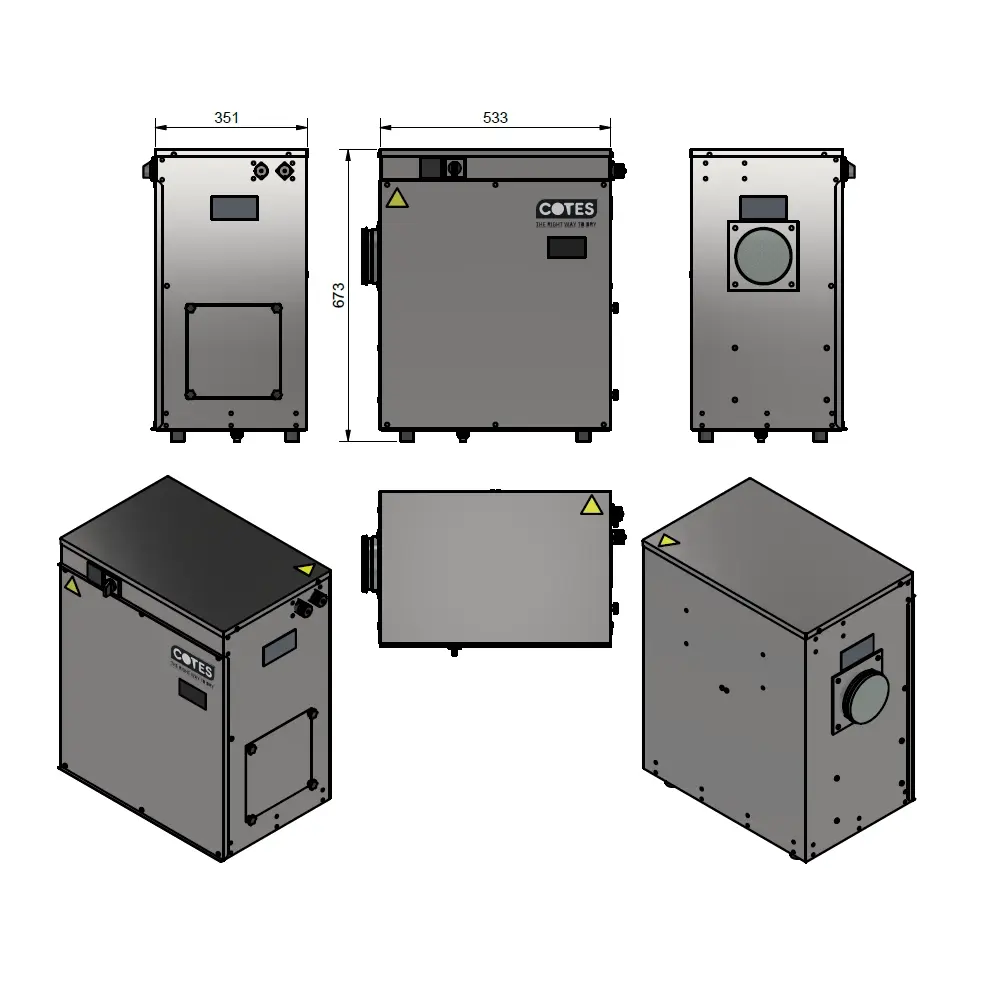
Model DRY AIR (M3/H) REGENERATION AIR (M3/H) CONNECTED LOAD (kW) MOISTURE REMOVAL CAPACITY (KG/H) DIMENSIONS (WxDxH) DATASHEET PRODUCT MANUAL
CH22 115 N.A. 0,75 0,38 425 / 311 / 441 Datasheet
Request Manual
CH26 225 N.A. 1,6 0,6 533 / 351 / 673 Datasheet
Request Manual
check

CLOSED-CIRCUIT OPERATION   

Regeneration air remains inside the unit and moisture is removed through internal condensation instead of external exhaust airflow. 

check
APPLICATION KNOW-HOW

Designed for installations where external regeneration ducting is impractical, including archives, laboratories, storage rooms and technical facilities. 

check
ADSORPTION DRYING PRINCIPLE 

Rotor-based adsorption drying provides stable moisture removal across varying temperature conditions. 

check
COMPACT HYBRID DESIGN  

Compact stainless-steel cabinet designed for installation in constrained spaces with minimal infrastructure requirements. 

Frequently Asked Questions

For our full FAQ section you can go to www.cotes.com/FAQ 

On this page we highlight some of the more frequently asked questions from customers.


When should a hybrid dehumidifier be used instead of a conventional adsorption system?
open close

Hybrid units are typically selected when regeneration air cannot be ducted outside the building. The CH26 enables adsorption drying in installations where external ducting is not possible. 

 The regeneration air loop remains inside the unit. Moisture released from the rotor is condensed internally and removed as liquid water through a drain connection. 

Hybrid systems still rely on adsorption drying using a rotor. The difference lies in the regeneration process, where moisture is condensed internally instead of being exhausted through ducting.

Humidity control reduces condensation, limits corrosion risk and stabilises insulation resistance during turbine restart after standstill.