BM_Ultrady_Man-with-Reflection_Sustainable-Battery-27072023
Cotes Ultrady Production Doors-min-1-1
Product Thumbnail 1000x1000 How Ultradry works
BM_Ultrady_Man-with-Reflection_Sustainable-Battery-27072023
Cotes Ultrady Production Doors-min-1-1
Product Thumbnail 1000x1000 How Ultradry works

Cotes Ultradry

Ultra-low humidity dry-air systems for battery dry rooms

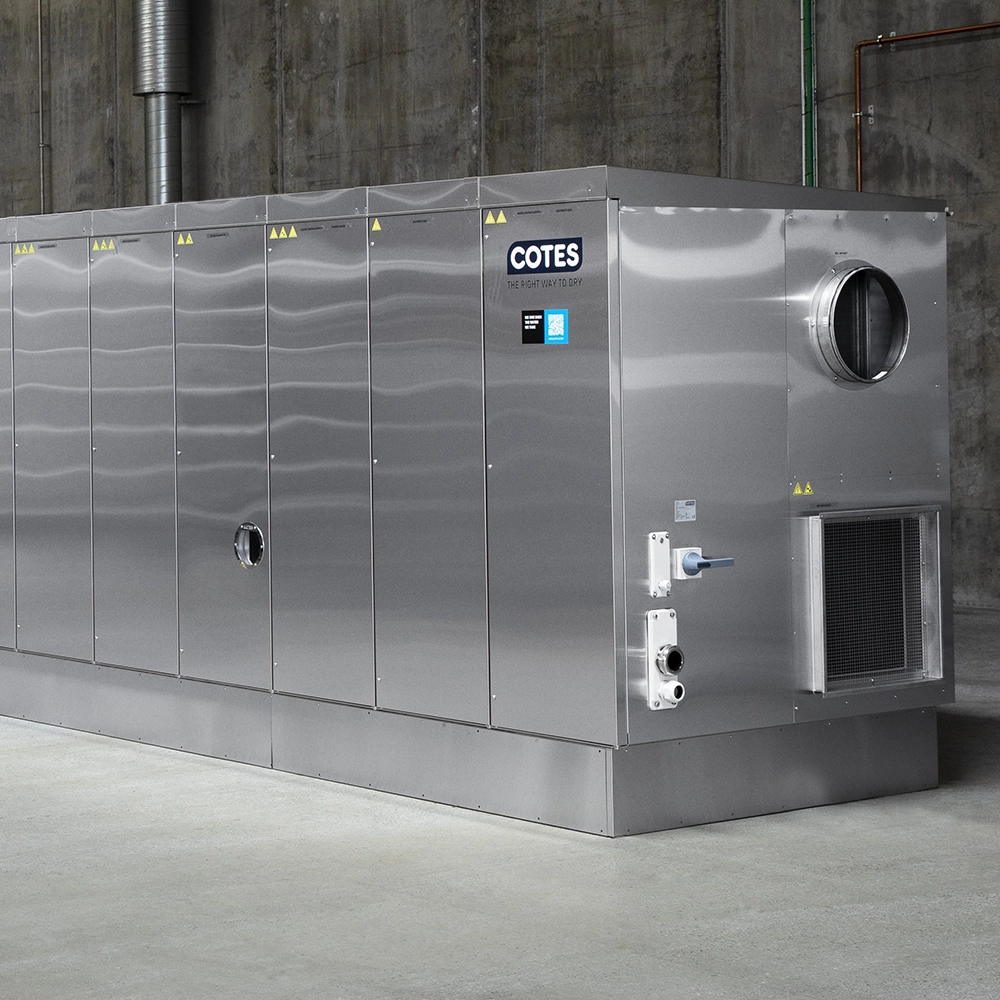
Cotes Ultradry is a high-performance adsorption dry-air system developed for applications requiring extremely low humidity levels and very low dew points.

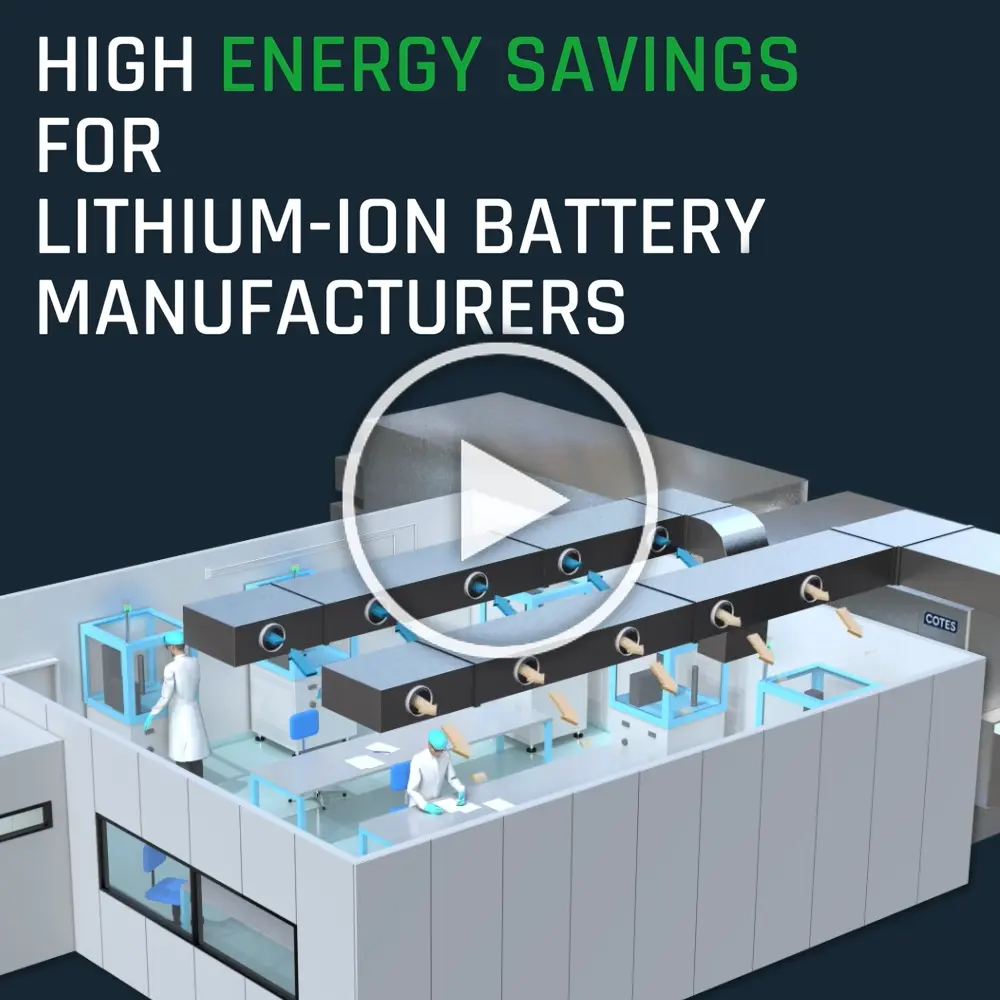
The system is primarily designed for battery dry rooms in lithium-ion battery manufacturing, where stable ultradry environments are critical for production quality and process stability.

Unlike conventional dry-room dehumidification systems that rely heavily on high-temperature electrical heating, Cotes Ultradry uses Cotes Exergic Technology®, which enables regeneration using low-temperature heat sources such as hot water.

This approach significantly reduces electrical energy consumption while maintaining the very low dew points required in battery production environments.

Explanation of Naming

The product designation reflects the system’s primary function:

  • Ultra – extremely low humidity levels
  • Dry – ultra-dry air production for critical manufacturing environments

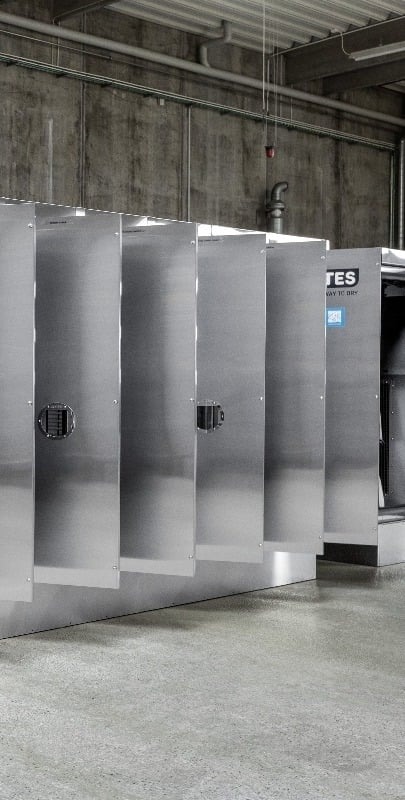
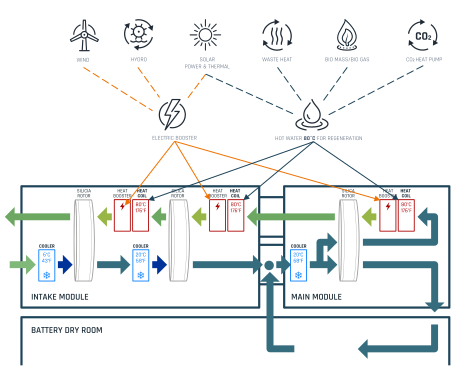
The Ultradry platform refers to a system architecture consisting of intake modules and main drying modules rather than a single dehumidifier unit.

System Architecture

Cotes Ultradry systems typically consist of two main elements:

Intake modules
Pre-dry incoming air before it enters the main drying stage.

Main modules
Perform the final drying stages required to reach ultra-low dew points for battery dry rooms.

Depending on the project requirements, systems can be configured as:

  • Two-stage systems
  • Three-stage systems

This modular architecture allows systems to scale with dry room size and required dew point levels.

Typical APplications

Cotes Ultradry systems are primarily used in battery manufacturing environments, including:

  • lithium-ion battery dry rooms
  • gigafactory production facilities
  • battery research and development labs
  • pilot production lines

These environments require extremely low and stable humidity levels to prevent reactions between lithium compounds and moisture.

Read more + Read less -
Ultra-low dew point capability: Designed to achieve dew points typically ranging from −40 °C down to −120 °C in controlled dry-room environments.
Exergic Technology®: Patented multi-stage adsorption technology enabling regeneration with low-temperature heat sources.
Reduced electrical energy consumption: Systems can significantly reduce electrical heating demand compared to conventional dry-room dehumidification systems.
Multi-stage adsorption architecture: Uses multiple silica-gel rotors arranged in stages to progressively reduce moisture levels.
Flexible energy sources: Compatible with hot water from heat pumps, waste heat, solar thermal systems or other sustainable energy sources.
Scalable system architecture: Built from intake and main modules that can be combined to match the airflow and dew-point requirements of the dry room.
Request a quote

TECHNICAL DATA

Model DRY AIR (M3/H) REGENERATION AIR (M3/H) CONNECTED LOAD (kW) MOISTURE REMOVAL CAPACITY (KG/H) DIMENSIONS (WxDxH) DATASHEET PRODUCT MANUAL
C125 12000 2600 93 65 2433 / 1710 / 2052 Datasheet
Request Manual
C150 18000 4000 147 103 3044 / 1910 / 2252 Datasheet
Request Manual
C180 25000 5400 199 138 3044 / 2410 / 2552 Datasheet
Request Manual
C194 35000 6800 249 173 3655 / 2410 / 2852 Datasheet
Request Manual
check

ULTRA-LOW HUMIDITY CONTROL

Designed for industrial environments where extremely low dew points are required for manufacturing processes.

check

MULTI-STAGE ADSORPTION DRYING

Uses multiple adsorption rotors to progressively reduce moisture levels.

check

LOW-TEMPERATURE REGENERATION

Exergic Technology® enables regeneration using low-temperature heat sources such as hot water.

check

INDUSTRIAL SYSTEM INTEGRATION

Systems are designed to integrate with dry-room air handling systems and industrial control architectures.

Frequently Asked Questions

For our full FAQ section you can go to www.cotes.com/FAQ 

On this page we highlight some of the more frequently asked questions from customers.


Why are ultra-low humidity levels required in battery production?
open close

Lithium-ion battery manufacturing processes involve materials that react with moisture. Even small amounts of humidity can affect product quality and production stability.

Dry rooms maintain extremely low humidity levels to prevent moisture contamination during production.

 Traditional dry-room systems rely heavily on high-temperature electrical heating for regeneration. Exergic Technology® allows regeneration using lower-temperature heat sources such as hot water, reducing electrical energy consumption. 

 Ultradry systems are designed to achieve very low dew points typically ranging from −40 °C down to −120 °C, depending on system configuration and process requirements. 

 Yes. The regeneration process can utilise heat from heat pumps, waste heat, solar thermal systems or other sustainable energy sources.