


Control, flexibility and system design trade-offs
Adsorption dehumidifiers are often described by the number of air connections – or ports – they have. At first glance, the distinction between 3-port and 4-port machines may appear to be a mechanical detail.
In practice, the number of ports reflects a fundamental design choice that affects airflow control, system integration and operational stability.
Understanding this distinction is therefore important when selecting a dehumidifier for a specific installation.
The 4-port principle: two air streams and independent control
Most industrial adsorption dehumidifiers are designed as 4-port machines.
In this configuration, the unit operates with two completely separate air streams:
- Process air – the air that must be dried
- Reactivation air – the air used to remove moisture from the silica gel rotor
Each air stream has its own airflow path through the rotor and is normally driven by its own dedicated fan.
This results in four air connections:
- Process air inlet
- Process air outlet (dry air)
- Reactivation air inlet
- Reactivation air outlet (hot, humid exhaust air)
During operation, the process air and reactivation air pass through different sectors of the rotor, typically in opposite directions.
Because the air streams are separated, their airflow rates can be controlled independently.
Practical implications of the 4-port design
Independent airflow control provides several important system advantages.
The airflow in the process air circuit and the reactivation air circuit can be adjusted individually in order to:
- maintain the correct drying performance
- compensate for pressure losses in duct systems
- optimise the balance between capacity and energy use
This flexibility makes the 4-port design well suited for installations where:
- duct systems introduce significant or variable pressure losses
- airflow conditions may change during operation
- stable and predictable drying performance is required
For these reasons, 4-port dehumidifiers are commonly used in industrial installations and engineered drying systems.
Cotes 4-port adsorption dehumidifiers
Cotes applies the 4-port principle across a large part of its adsorption dehumidifier range, including:
CR100, C30, C35, C65, C105, C125, C150, C180 and C194. Compare these dehumidifiers.
These units are designed for installations where separate control of process and reactivation airflow is required to maintain stable drying performance under varying system conditions.
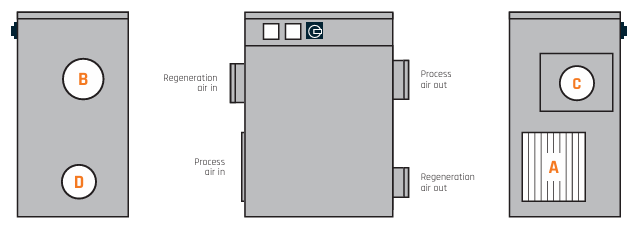
Below is an example of the CR100:
A) PROCESS AIR INLET
B) PROCESS AIR OUTLET
C) REGENERATION AIR INLET
D) REGENERATION AIR OUTLET
The 3-port principle: simplified airflow design
Adsorption dehumidifiers can also be designed using a single fan configuration.
In this arrangement, the fan pushes air through the rotor. Downstream of the rotor, the airflow is divided into two streams using fixed resistances or pressure losses.
One part of the airflow leaves the unit as dry process air, while the remaining portion is heated and used as reactivation air.
This configuration results in three air connections:
- Air inlet
- Dry air outlet
- Wet exhaust air outlet
The design reduces the number of components and simplifies the internal airflow arrangement.
System limitations of 3-port machines
Because a 3-port unit uses a single fan, the airflow distribution between process air and reactivation air is determined by pressure losses in the system.
This means the airflow balance depends on the resistance in the connected ductwork.
If the pressure conditions change, the airflow split between the two streams may also change.
For example:
- increased resistance on the dry air outlet may reduce the process airflow
- increased resistance on the wet air outlet may alter the reactivation airflow
When the airflow ratio changes, the unit may operate outside its intended balance between drying air and regeneration air. This can affect:
- drying capacity
- energy consumption
- operational stability
For this reason, 3-port dehumidifiers require carefully defined airflow conditions and well-controlled duct systems.
Cotes 3-port adsorption dehumidifiers
Cotes offers several adsorption dehumidifiers based on the 3-port principle, including:
CL26, CR80B, CR240B, CR290B and CR400B. Compare these dehumidifiers.
These units are typically used in applications where:
- the duct layout is simple and well defined
- pressure conditions remain stable
- installation space or mechanical simplicity is a priority
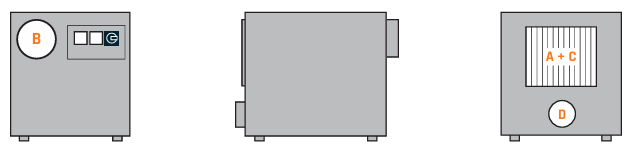
Below is an example of the CR400B:
A) PROCESS AIR INLET
B) PROCESS AIR OUTLET
C) REGENERATION AIR INLET
D) REGENERATION AIR OUTLET
Selecting the appropriate design
Choosing between a 3-port and a 4-port adsorption dehumidifier is primarily a system design decision.
A 4-port configuration provides:
- independent airflow control
- higher flexibility when integrating with duct systems
- more stable performance when pressure conditions vary
A 3-port configuration provides:
- a simpler mechanical design
- fewer components
- a compact unit suitable for installations with predictable airflow conditions
Conclusion
The number of ports on an adsorption dehumidifier reflects how airflow is managed inside the unit and how the system interacts with the surrounding duct installation.
A 4-port design separates process and reactivation airflow, allowing each air stream to be controlled independently. This provides flexibility and stable operation in complex systems.
A 3-port design simplifies the airflow arrangement, but requires carefully defined pressure conditions to maintain the correct balance between drying and regeneration.
By offering both principles across its product range, Cotes allows system designers to select the configuration that best fits the technical requirements of the installation.