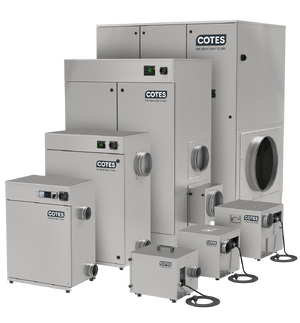
In demanding industrial environments, reliable humidity control is often taken for granted until conditions push technology to its limits. One such case unfolded high above sea level in the Swiss Alps, where adsorption dehumidification proved indispensable for safeguarding critical hydropower infrastructure. At the heart of it stood a valve chamber inside the Curnera Dam, located at an altitude of approximately 2,000 meters above sea level, deep within the mountain massif near Sedrun.
The Challenge: Humidity Control Deep Inside the Mountain
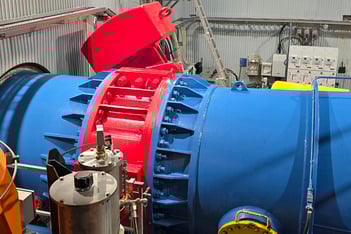
Inside the valve chamber, low temperatures combined with persistent humidity levels created conditions that threatened sensitive mechanical and electrical components. Stable humidity levels were essential to protect the newly installed turbine equipment, especially throughout the Alpine winter.
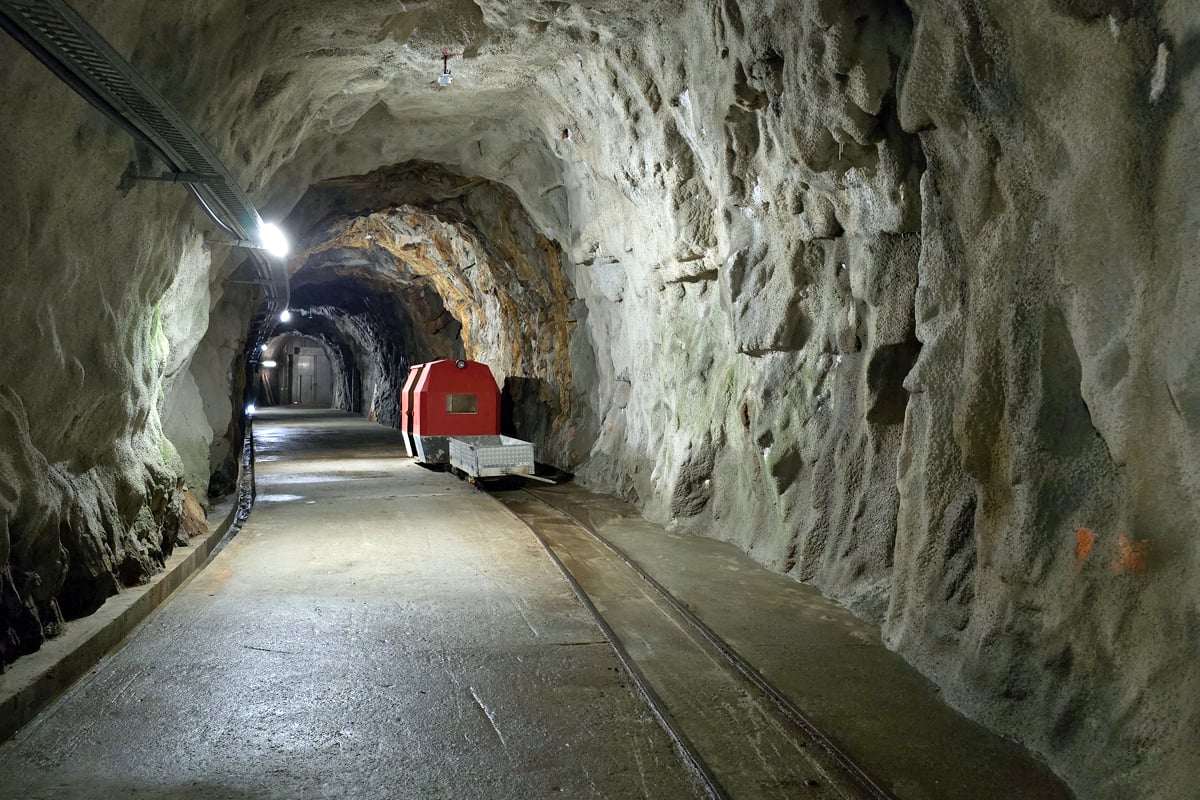
Reaching the valve chamber illustrates the complexity of the task: from the dam crest, access led through a rock tunnel, followed by a descent of around 150 meters by lift; from there, a man-high tunnel stretched another 500 meters into the heart of the mountain. Maintenance or emergency repairs could not be carried out quickly or casually.
|
|
Why Adsorption Dehumidification Was the Only Viable Solution
Conventional condensation-based systems were not suitable for this environment. The application demanded a solution that could perform independently of room temperature while maintaining a stable dew point under cold conditions. Adsorption dehumidification offered exactly these strengths.
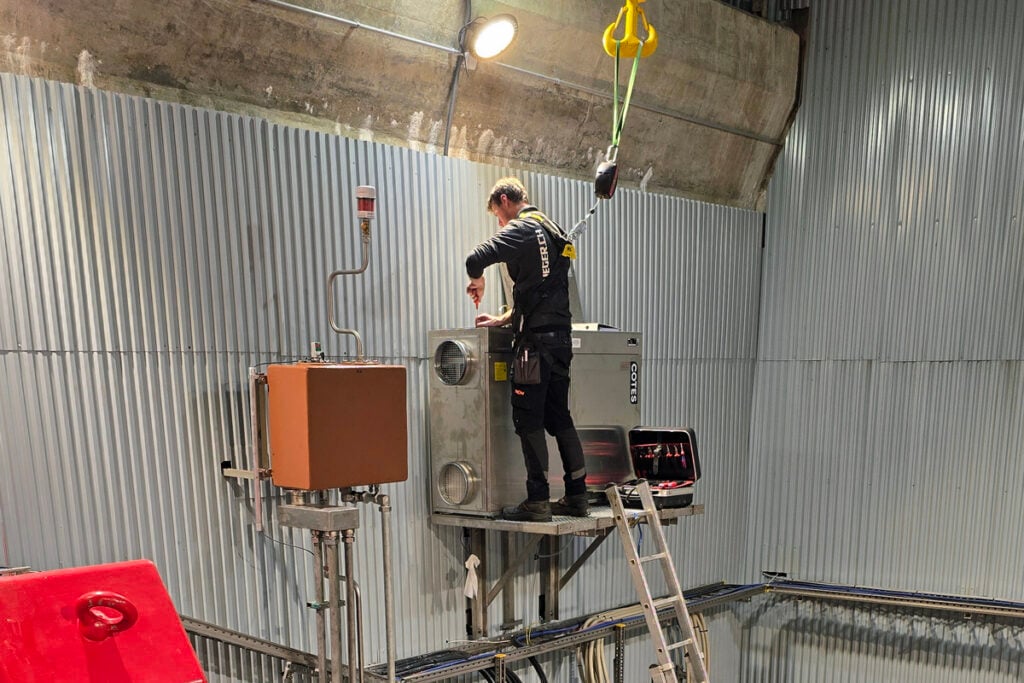
A Cotes C35E adsorption dehumidifier was selected to ensure reliable humidity management in the valve chamber by Cotes’ suisse partner, Krüger A/S.
Shortly before commissioning, heavy snowfall closed access to the site via the Oberalp Pass. Despite this, dehumidification was urgently required during the winter months due to the turbine installation.
What was meant to be a standard technical visit turned into a true alpine operation. The journey led by car to Sedrun, onward by the Matterhorn-Gotthard Railway to the Oberalp Pass, and then on snowshoes to the tunnel entrance. From there, a battery-powered vehicle carried the team more than four kilometers through the mountain.
After descending 150 meters by elevator inside the dam, the final 500-meter tunnel walk led to the valve chamber, where the system was provisionally commissioned under extreme conditions.
Results: Reliable Dehumidification Under Extreme Conditions
Despite the extraordinary circumstances, the adsorption dehumidification system performed flawlessly after the adsorption unit was implemented with an LK module. The LK module can be used to drain away the moisture where ventilation isn’t possible. Humidity levels were reliably reduced, and the sensitive turbine equipment was effectively protected throughout the winter.
Permanent piping and final installation could only be completed the following spring once the snow melted and access by road was restored. The result of this installation is a stable, long-term solution capable of operating continuously in one of the most challenging environments imaginable.
This installation stands as a powerful example of what adsorption dehumidification can achieve when paired with expertise, planning, and adaptability.
Technical Overview: C35E Adsorption Dehumidifier
.png?width=3144&height=3840&name=20210609%20Productimage%20C35%20-%20Steel%20overlay%20(1).png)
|
|
Do you operate in environments where conventional dehumidification reaches its limits?
Talk to our experts to discover how adsorption dehumidification can protect your critical infrastructure.